
Insights: Alerts
Substantially Similar or Plainly Dissimilar? The Ordinary Observer Split
Range of Motion Products, LLC v. Armaid Company Inc., No. 2023-2427 (Fed. Cir. Feb. 2, 2026)
In a closely watched design patent decision, the Federal Circuit affirmed summary judgment of non-infringement in favor of Armaid, holding that a patented “Body Massaging Apparatus” (U.S. Design Patent No. D802,155) was appropriately construed narrowly to exclude functional elements, and that no reasonable jury could find the accused device substantially similar.
In a dissenting opinion, Chief Judge Moore took issue with the court’s consideration of whether the two designs were “plainly dissimilar,” rather than whether the two designs were “substantially similar,” arguing the former standard subtly shifts the ordinary observer’s focus from similarities to differences.
The case reinforces the impact of functionality on design patent scope, although the strong dissent signals possible reconsideration of how design patent infringement is analyzed.
The Majority: Functionality Can Significantly Limit Design Scope
The majority opinion authored by Judge Cunningham emphasizes that courts must distinguish between ornamental and functional aspects of a patented design before conducting the infringement analysis.
Key aspects of the patented device—particularly the “clamshell” shape of its opposing arms—were deemed functionally driven. The court relied on:
-
A related, prior art utility patent describing limb-massaging functionality,
-
Marketing materials touting leverage and performance benefits, and
-
Evidence that alternative designs would affect utility.
Set forth below are illustrations of the claimed design, the accused product, and the earlier product embodying the prior art utility patent referenced by the court.
| Claimed Design (D'155 Patent) |
Accused Product |
Earlier Product Embodying Prior Art Utility Patent (Armaid1) |
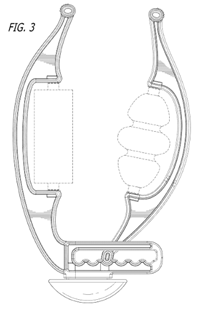 |
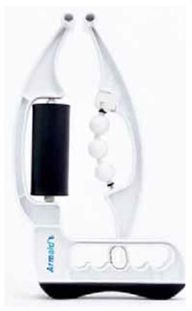 |
 |
Because many features of the patented design were constrained by function, the court held that the design patent’s scope was correspondingly narrow.
When comparing the accused product to the claimed design under the ordinary observer test, the court concluded the designs were “plainly dissimilar” after accounting for functional elements, and so summary judgment of non-infringement was warranted. Differences in hinge structure, proportions, segmentation, and overall visual impression were enough for the Federal Circuit to affirm the summary judgment of non-infringement.
Notably, the court rejected the argument that simply placing the products side-by-side was enough to create a jury issue.
The Dissent: Has the Court Drifted From the “Substantial Similarity” Test?
Chief Judge Moore dissented, arguing that the question of “substantial similarity” should have been decided by the jury.
The dissenting opinion raises several broad concerns:
-
The Federal Circuit’s use of the “plainly dissimilar” test, rather than the “substantial similarity” test, subtly shifts the focus from similarities to differences.
-
The Supreme Court’s original test in Gorham v. White asks whether designs are substantially similar in overall appearance, not whether they are sufficiently distinct.
-
Increasingly, design patent cases are being resolved at summary judgment rather than by juries.
The dissent suggests the court should revisit its framing of the infringement standard—particularly the role of summary judgment in close design cases.
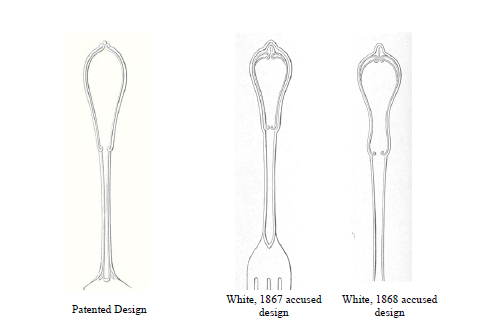
A quick visual review of the flatware designs at issue in the Gorham v. White case illustrates how one can find differences as well as similarities, and also how one can find arguments regarding functionality:
Judge Moore also made this point with an illustration of a children’s puzzle, below, noting that when the ordinary observer is tasked specifically with finding differences, similarities may be overlooked:

Why This Case Matters for Design Rights
This decision offers several practical lessons for design patent owners:
1. Functionality Evidence Can Narrow Enforcement Scope
Utility patents, technical constraints, and marketing materials can significantly limit the breadth of design protection.
2. Solid-Line Elements Are Not Immune From Functionality Analysis
Depicting features in solid lines does not prevent courts from finding them functionally driven.
3. Designs Close to Prior Art Receive Narrower Protection
Where a design differs only modestly from prior art, small differences in accused products may carry greater weight.
4. Summary Judgment Remains a Powerful Defense Tool
Courts continue to affirm non-infringement at summary judgment where ornamental differences are pronounced after filtering out functional elements.
5. The Law May Not Be Settled
The dissent highlights an ongoing doctrinal debate that could lead to further Federal Circuit or en banc review.
Strategic Considerations
For companies investing in product design:
-
Build a record demonstrating ornamental flexibility, not just functional performance.
-
Be mindful that marketing materials emphasizing functional benefits may later narrow enforcement scope.
-
Evaluate design patent portfolios with an eye toward prior art proximity and functional overlap.
-
Consider enforcement strategy early, including summary judgment risk.
This decision underscores the evolving balance between form and function in design patent protection—and the importance of strategic planning from prosecution through litigation.
Related People

Disclaimer
While we are pleased to have you contact us by telephone, surface mail, electronic mail, or by facsimile transmission, contacting Kilpatrick Townsend & Stockton LLP or any of its attorneys does not create an attorney-client relationship. The formation of an attorney-client relationship requires consideration of multiple factors, including possible conflicts of interest. An attorney-client relationship is formed only when both you and the Firm have agreed to proceed with a defined engagement.
DO NOT CONVEY TO US ANY INFORMATION YOU REGARD AS CONFIDENTIAL UNTIL A FORMAL CLIENT-ATTORNEY RELATIONSHIP HAS BEEN ESTABLISHED.
If you do convey information, you recognize that we may review and disclose the information, and you agree that even if you regard the information as highly confidential and even if it is transmitted in a good faith effort to retain us, such a review does not preclude us from representing another client directly adverse to you, even in a matter where that information could be used against you.
